
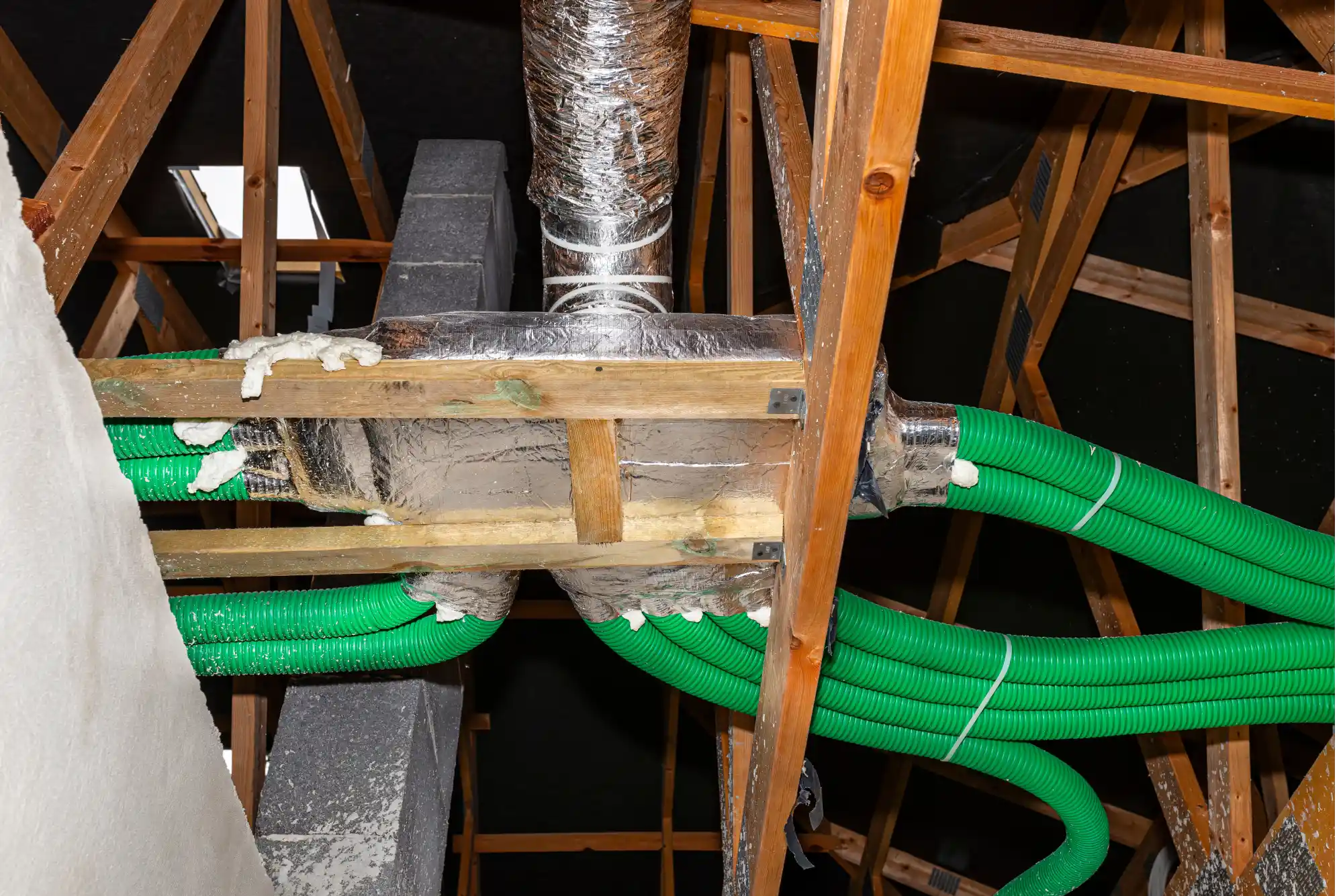
HVAC Air Duct Inspection With Camera: Complete Diagnostic Guide, Costs, And Process
Table of Contents
Technical Mechanics of HVAC Camera Inspections
An HVAC camera inspection utilizes flexible optical probes with multi-directional lighting to evaluate enclosed duct interiors without destroying structural walls. In our field operations, articulating optical heads capture high-definition video while integrated 512 Hertz sonde transmitters emit electromagnetic signals through building materials, pinpointing structural breaches, moisture damage, and severe blockages accurately.
Standard visual checks through supply grilles obscure over 80 percent of an air distribution network. Our commercial optical rigs traverse up to 150 feet using fiber-reinforced push rods through main supply trunks, return drops, and internal branch junctions. We adhere to diagnostic protocols established by the National Air Duct Cleaners Association (NADCA) ACR Standard to establish objective benchmarks for structural integrity and cleanliness.
High-intensity dimmable LED arrays prevent video washout on reflective galvanized sheet metal while illuminating dark cavities in flexible ductwork. Fiber-reinforced push rods provide the axial stiffness needed to navigate sharp 90-degree elbows without buckling or coiling. Integrated 512 Hertz sonde transmitters project signals through concrete slabs and sheetrock, enabling our technicians to track probe locations above ground using directional radio frequency wands.
| Optical & Diagnostic Feature | Entry-Level Consumer Scope | Professional Commercial Duct Camera |
|---|---|---|
| Sensor Video Resolution | 720p Standard HD | 1080p HD to 4K Ultra HD |
| Probe Cable Length | 3 feet to 16 feet | 50 feet to 150 feet |
| Steering Articulation | Fixed angle or 2-way manual | Motorized 4-way 360-degree continuous |
| Location Tracking | None | Built-in 512 Hz sonde transmitter |
| Illumination Array | Standard fixed LEDs | Adjustable multi-directional LED ring |
| Telemetry & Reporting | Basic internal MicroSD storage | Real-time digital reporting with distance telemetry |
Essential Diagnostic Indicators for Video Duct Audits
We perform video duct audits when physical symptoms indicate hidden airflow obstructions, persistent biological contamination, or severe energy loss that register checks cannot diagnose. Deploying remote optical sensors into main distribution trunks allows our field teams to verify indoor air quality triggers, vermin intrusion, unsealed duct joints, and construction dust before recommending invasive structural remediations.
Unexplained indoor air quality degradation remains a primary reason for scheduling an internal video audit. Dust accumulating on furniture shortly after filtration cycles often indicates unsealed return air drops pulling dirt from crawlspaces or attics. Guidance published by the U.S. Environmental Protection Agency (EPA) notes that an air distribution system requires detailed internal evaluation whenever there is evidence of substantial visible microbial growth, vermin infestation, or severe debris clogging supply grilles.
Uneven airflow distribution across building zones also signals internal duct compromise. When specific rooms experience noticeable thermal drops, our cameras routinely uncover collapsed flexible duct liners, disconnected collar joints, or foreign objects trapped inside branch lines. Furthermore, post-construction evaluations routinely reveal drywall mud, saw dust, and discarded building debris left inside main return trunks during home remodeling.
Four-Step Professional Duct Camera Inspection Process
Our four-step professional duct camera inspection process systematically gathers conclusive diagnostic evidence without damaging sensitive flexible liners or fiberglass duct boards. By combining electrical safety isolation, controlled optical probe navigation, high-frequency electromagnetic locating, and digital reporting, we pinpoint internal anomalies with exact spatial accuracy throughout complex residential and commercial building ductwork.
- System Power Down and Access Port Preparation: We isolate the HVAC system at the primary electrical breaker panel to prevent unexpected blower activation during camera insertion. We temporarily remove supply registers and install gasketed access ports into main plenum boxes using specialized containment flanges.
- Controlled Camera Feed Navigation: We carefully insert the flexible fiber-rod camera system into supply trunks and main return drops. The probe advances incrementally at 6 to 12 inches per second while an operator uses 360-degree motorized pan-and-tilt controls to examine all interior duct surfaces.
- Defect Mapping via Sonde Transmitter: Upon locating structural ruptures, microbial colonies, or air leaks, we halt probe movement and activate the integrated 512 Hertz internal transmitter. A technician sweeps an above-ground locator wand over floors, walls, or ceilings to pinpoint the precise location of the anomaly.
- Video Documentation and Report Archiving: High-definition digital video footage and still photos are recorded throughout the camera run. Our diagnostic team compiles this imagery into a comprehensive report detailing defect locations, severity levels, and specific remediation protocols.
Internal Duct Anomaly Identification and Real-World Case Studies
Optical duct camera diagnostics reveal hidden structural degradations, biological growth, and physical blockages across diverse ducting materials that remain invisible from vent grilles. By analyzing live video feeds, we differentiate between flexible duct collapse, duct board moisture erosion, and sheet metal joint separation, enabling targeted, minimally invasive corrective repairs for property owners.
Duct construction materials exhibit distinct failure modes under continuous thermal stress and elevated ambient humidity. Flexible coiled ducting easily sags, pinches, or tears when installed across attic joists without proper wide-strap support. Fiberglass duct board absorbs standing moisture if condensate drains clog, promoting biological growth along the porous inner surface. Galvanized sheet metal systems typically experience seal degradation over time, causing conditioned air leakage at unsealed transverse joints.
In our field operations, we resolved a complex airflow failure in a two-story residential home where the second-floor master suite experienced complete cooling loss despite maximum air handler output. Our optical probe traversed 38 feet into the main distribution trunk and discovered a flexible duct collar that had completely detached inside an enclosed wall cavity, dumping conditioned air into structural framing. By activating the camera head’s 512 Hertz sonde transmitter, we located the breach behind a hallway wall and cut a small 12-inch access opening to reattach and seal the connection, saving the homeowner thousands of US dollars in exploratory demolition.
In a commercial office facility, occupants reported persistent musty odors during cooling cycles, yet external checks revealed no visible duct damage. When we deployed an articulating video camera through the main supply plenum, the video feed revealed three gallons of stagnant condensate pooling inside a sagging duct board section caused by an unlevel rooftop pad. The camera highlighted active mold growth spanning ten lineal feet of plenum lining, allowing us to level the equipment pad, replace the contaminated duct board section with insulated sheet metal, and eliminate the odor source completely.
| Physical Symptom | Hidden Camera Discovery | Recommended Corrective Remediation Protocol |
|---|---|---|
| Musty smell when cooling engages | Standing water pooling in supply plenum with mold colonies | Clear condensate lines, sanitize non-porous surfaces, re-pitch duct section |
| Airflow loss in single room | Disconnected or crushed flex duct inside wall cavity | Reattach collar joint, seal with mastic, secure flex run every 4 feet |
| Persistent whistling noise | Separated sheet metal seam blowing air into floor joists | Seal open seam with fiberglass mesh and UL 181A-M mastic sealant |
| Rapid dust accumulation post-remodel | Drywall dust and construction grit coating return trunk | Mechanical brush agitation combined with HEPA negative air containment |
| Rust stains on ceiling vents | Condensate overflow or missing exterior duct insulation wrap | Insulate exterior duct surfaces to prevent ambient dew point condensation |
HVAC Video Duct Inspection Cost and Service Framework
A standalone professional video camera duct inspection costs between 150 US dollars and 300 US dollars, though service providers routinely waive this fee when bundled with comprehensive cleaning or structural repairs. Investment choices depend on system complexity, where basic thermal complaints require camera diagnostic probes, whereas severe efficiency drops demand combined video and pressure differential testing.
Selecting the appropriate diagnostic protocol requires a structured decision framework based on observed building symptoms. If you suspect localized structural disconnects, pest intrusions, or localized blockages, prioritize an optical camera inspection equipped with a 512 Hertz locating sonde. If your primary objective is reducing utility spending, combine camera audits with duct blaster pressure differential testing to measure cubic feet per minute air leakage across unconditioned spaces. When planning full system sanitization, select a service provider who includes post-cleaning video verification to confirm complete contaminant removal.
| Diagnostic Inspection Tier | Average Industry Cost | Technical Deliverables Included | Recommended Application Scenario |
|---|---|---|---|
| Basic Visual Register Check | 75 US dollars to 150 US dollars | External vent check, filter check, air handler cabinet review | Routine seasonal maintenance checks |
| Video Camera Inspection | 150 US dollars to 300 US dollars | Internal optic probe audit, high-definition recording, sonde localization | Suspected mold, pest intrusion, airflow blockages |
| Duct Leakage Pressure Test | 200 US dollars to 350 US dollars | Calibrated duct blaster pressure test measuring total leakage | High utility bills, energy efficiency auditing |
| Comprehensive System Audit | 250 US dollars to 450 US dollars | Video camera inspection, pressure leakage testing, thermal imaging | Real estate transactions, severe IAQ complaints |
| Bundled Restoration Service | Included (0 US dollars fee) | Pre-cleaning optical audit and post-cleaning video verification | Scheduled air duct cleaning or repair services |
Frequently Asked Questions
How much does a professional HVAC camera duct inspection cost?
A standalone professional video camera duct inspection costs between 150 US dollars and 300 US dollars for standard single-family residential properties. Service providers frequently waive this diagnostic fee when homeowners bundle the inspection with comprehensive air duct restoration or sealing. Larger commercial properties or multi-zone residential duct networks typically cost between 300 US dollars and 600 US dollars based on total lineal footage and access port requirements.
Can an internal optical camera detect hidden mold in ductwork?
Yes, high-definition 1080p optical camera systems directly identify visible biological growth, fungal colonies, and moisture pooling inside dark duct trunks. While optical inspection confirms visual microbial structures, precise species identification requires taking surface tape lift samples for laboratory analysis. The Environmental Protection Agency notes that verified visible mold inside hard-surface ducts warrants targeted mechanical cleaning and immediate moisture remediation.
How long does a full video camera duct inspection take?
A thorough video camera inspection for a typical residential duct network takes between 1 and 2 hours to complete. Complex multi-zone commercial duct networks or residential homes with inaccessible attic runs may require 3 to 4 hours of total diagnostic time. The duration depends heavily on the number of supply registers, the availability of main plenum access ports, and the severity of identified internal blockages.
Can homeowners perform DIY duct inspections with consumer scope cameras?
Homeowners can use low-cost consumer endoscopes for short visual checks directly behind vent grilles, but these devices cannot perform comprehensive duct diagnostics. Consumer devices lack the high-tensile push cables, 360-degree motorized articulation, powerful illumination arrays, and 512 Hertz location sondes necessary to navigate deep branch junctions and map hidden wall breaches. Relying on short DIY scopes leaves over 80 percent of the internal duct network unexamined.
How frequently should an HVAC video duct audit be conducted?
We recommend scheduling a professional video camera duct audit every 3 to 5 years under standard residential operating conditions. Immediate camera audits should be performed following major interior remodeling projects, persistent indoor moisture incidents, unexplained spikes in utility costs, or evidence of pest infestation. Commercial facilities adhering to NADCA standards should conduct annual visual and camera assessments to ensure optimal indoor environmental safety.
Sources
- National Air Duct Cleaners Association (NADCA) – ACR Standard for Assessment, Cleaning, and Restoration of HVAC Systems: https://nadca.com/
- U.S. Environmental Protection Agency (EPA) – Should You Have the Air Ducts in Your Home Cleaned?: https://www.epa.gov/indoor-air-quality-iaq/should-you-have-air-ducts-your-home-cleaned