
Thinking About A New AC Installation? Here’s What You Should Know
Table of Contents
System Sizing and Thermal Load Calculations
A new air conditioning installation requires accurate equipment sizing based on precise thermal load calculations rather than simple square-footage estimates. Oversized cooling systems cycle on and off rapidly, failing to remove atmospheric humidity, while undersized units run continuously without reaching thermostat set points, causing premature equipment failure and inflated utility bills.
In our field operations across north Florida, we frequently encounter homes suffering from improper sizing. For example, we recently evaluated a 2,400-square-foot home where the homeowner experienced persistent indoor humidity exceeding 70 percent and severe short-cycling. A previous contractor had installed a five-ton cooling system based purely on floor area, assuming larger tonnage would provide faster cooling. We conducted an Air Conditioning Contractors of America Manual J calculation, evaluating window solar heat gain coefficients, attic insulation values, and wall orientations. Our diagnostic confirmed the house required only a 3.5-ton system. After we replaced the oversized unit with a properly calculated 3.5-ton two-stage cooling system and modified the supply plenum, indoor humidity dropped to a comfortable 48 percent, and monthly power consumption decreased substantially.
When evaluating cooling load requirements for any property, we apply specific conditional criteria:
- If your building features high ceiling volumes and west-facing glass exposures, prioritize advanced heat gain calculations that account for radiant solar loads.
- If your structure has dense insulation and air-tight envelope sealing, select variable-capacity cooling equipment to prevent short-cycling during low-load periods.
- If your existing system struggles only during peak afternoon heat, verify air distribution static pressures before altering unit tonnage.
Seasonal Efficiency Ratings and Modern SEER2 Standards
Selecting an air conditioning system requires evaluating Seasonal Energy Efficiency Ratio 2 ratings to match equipment performance with local climate demands. Higher efficiency ratings reduce long-term operational power draw, but equipment cost trade-offs must be evaluated based on annual cooling hours and regional climate demands in your local area.
Federal regulations enforced by the U.S. Department of Energy mandate a minimum efficiency baseline of 14.3 SEER2 for split-system air conditioners installed in southern climate zones. The updated SEER2 testing methodology subjects cooling equipment to five times higher external static pressure during laboratory testing to replicate real-world duct resistance. Moving from an outdated 10 SEER system to a modern baseline system reduces cooling power consumption by more than 30 percent.
| System Configuration | Efficiency Rating Range | Compressor Technology | Equipment Cost Investment | Dehumidification Capability |
| Standard Single-Stage | 13.4 to 14.3 SEER2 | Single-Speed Rotary or Scroll | Baseline capital expense | Basic humidity reduction |
| Mid-Tier Two-Stage | 15.2 to 17.5 SEER2 | Two-Stage Scroll | Moderate capital expense | Enhanced moisture removal |
| Variable-Speed Inverter | 18.0 to 22.0+ SEER2 | Variable-Capacity Inverter | Premium capital expense | Superior humidity control |
Investing in variable-speed equipment yields the highest return on investment in hot, humid climates where air conditioners run continuously for several months. For properties in milder regions with lower cooling hours, mid-tier two-stage systems offer an ideal financial trade-off between initial purchase price and operational savings.
Air Duct Performance and System Architecture
Connecting a high-efficiency air conditioner to degraded or leaking air ducts severely reduces cooling output, wastes energy, and compromises indoor air quality. Unsealed ductwork allows conditioned air to escape into unconditioned attics or crawlspaces while pulling airborne dust, insulation particles, and humidity directly into the home breathing space.
Data from the U.S. Environmental Protection Agency ENERGY STAR Program confirms that typical residential duct systems lose 20 to 30 percent of moving air to leakage, holes, and unsealed connections. During a recent service call, we inspected a client whose new high-efficiency heat pump was failing to cool secondary bedrooms. Our static pressure differential testing revealed a 35 percent air volume loss through disconnected ceiling collar joints in the attic ductwork. The leakage forced the air handler to draw 130-degree Fahrenheit attic air into the return stream. We performed comprehensive air duct cleaning, re-attached all duct collars using mechanical draw bands, and sealed every connection point with fiber-reinforced mastic sealant. The duct restoration recovered full airflow to the isolated bedrooms and reduced supply air discharge temperatures by eight degrees.
Common failure modes in air distribution systems include:
- Deteriorated duct tape adhesive causing complete branch separation at plenum take-offs.
- Excessively long, kinked, or crushed flexible ducting restricting total air volume delivery.
- Undersized return air grilles raising system static pressure, which overworks blower motors and freezes evaporator coils.
- Unsealed return boxes drawing mold spores and dust from crawlspaces into living areas.
Diagnostic and Installation Decision Framework
Choosing the right cooling technology requires balancing upfront equipment expenses against long-term operational efficiency, moisture control needs, and indoor comfort expectations. Evaluating compressor types, blower motor variations, and existing ductwork conditions allows home and business owners to select an optimal system tailored to specific mechanical requirements.
We utilize a defined decision framework when consulting with property owners during system evaluation:
- If existing air ductwork displays severe static pressure restrictions and cannot be modified, select a single-stage or two-stage system with a constant-torque ECM blower motor.
- If multi-zone temperature control and precise humidity removal are required, select a variable-speed inverter system paired with a fully communicating thermostat.
- If structural spaces lack ductwork entirely, install a ductless mini-split network to bypass distribution losses.
- If ductwork shows high leakage but structural access is good, perform duct sealing and insulation upgrades prior to sizing new cooling equipment.
Evaluating these parameters prevents installing advanced inverter equipment on restrictive, leaking ductwork, which suppresses equipment efficiency and leads to premature control board failures.
Step-by-Step HVAC System Replacement Process
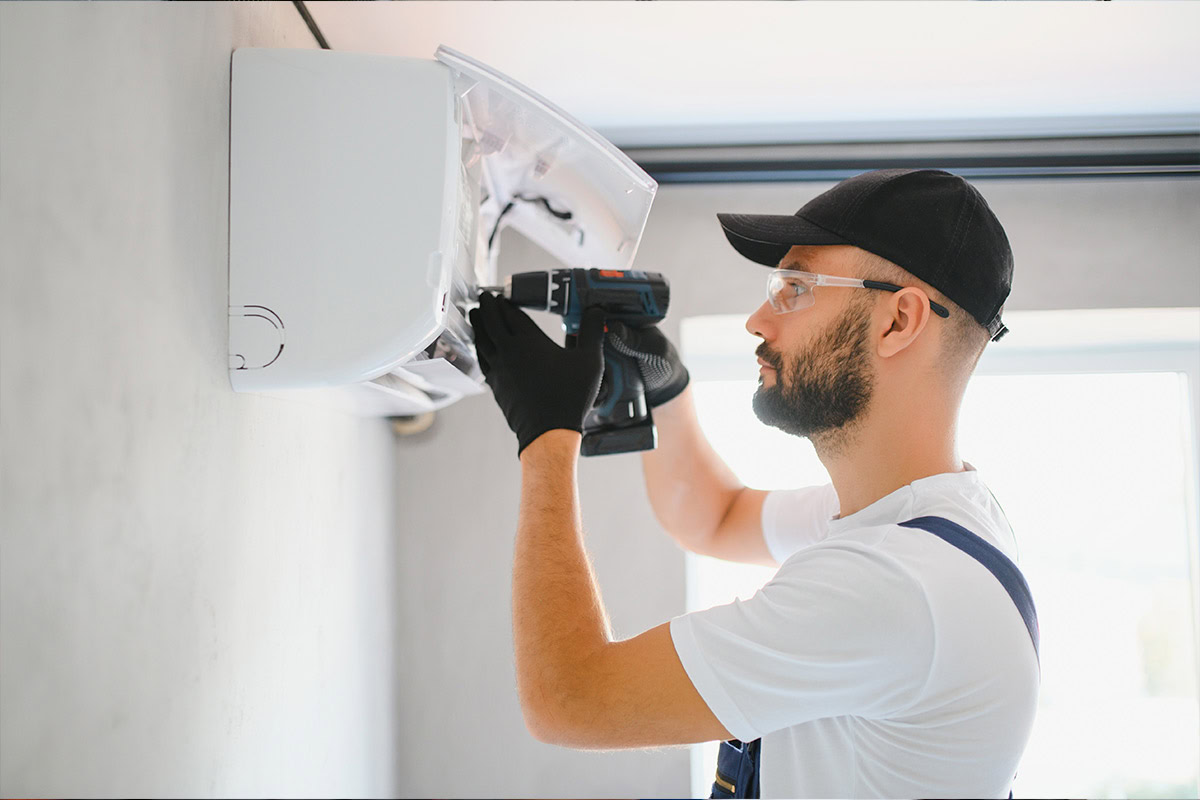
Executing a successful air conditioner replacement requires adhering to a strict, methodical installation sequence to ensure safety, efficiency, and system longevity. From initial refrigerant recovery to final airflow balancing, each sequential phase protects electrical components, seals airflow pathways, and verifies operational pressures according to manufacturer parameters.
- Recover existing refrigerant safely using an EPA-certified recovery machine and record total gas weight.
- Disconnect high-voltage electrical connections, drain lines, and duct connections to remove old equipment.
- Set the new outdoor condenser pad and level the platform using vibration-dampening isolation pads.
- Position the indoor air handler or evaporator coil, ensuring correct pitch for proper condensate drainage.
- Braze new copper line sets using a continuous dry nitrogen purge to prevent internal pipe oxidation.
- Pressurize the refrigerant lines with nitrogen to 400 PSI to verify system seal integrity.
- Pull a deep vacuum below 500 microns using a digital micron gauge to eliminate moisture and non-condensables.
- Release factory refrigerant, adjust total charge based on subcooling or superheat measurements, and balance airflow delivery across supply registers.
Frequently Asked Questions
Frequently Asked Questions
How long does a complete central air conditioner installation take?
A standard residential air conditioning system replacement typically takes between eight and ten hours to complete in a single day. Complex installations requiring custom duct modifications, line set replacements, or electrical panel upgrades may require two full working days.
What factors determine the overall cost of a new HVAC system?
The overall cost of a central air conditioning installation depends on system cooling capacity, efficiency ratings, mechanical complexity, and required duct repairs. Additional factors include electrical infrastructure updates, line set length, structural access modifications, and local municipal permit fees.
Should we replace the indoor air handler at the same time as the outdoor condenser?
Replacing both the indoor air handler and outdoor condenser simultaneously is essential to maintain matched system engineering, optimal energy efficiency, and full manufacturer warranty coverage. Mismatched components reduce cooling capacity, increase mechanical strain, and frequently lead to early compressor failure.
How often should ductwork be inspected and cleaned during system maintenance?
Air duct systems should undergo a professional inspection annually and receive comprehensive cleaning every three to five years depending on home occupant health conditions, pet ownership, and local dust exposure. Frequent filter changes help preserve clean duct interiors between major service intervals.
What maintenance steps maximize the lifespan of a newly installed AC system?
Maximizing system lifespan requires replacing air filters every one to three months, maintaining clear clearance around outdoor condenser coils, and scheduling professional bi-annual tune-ups. Routine service ensures proper refrigerant charge, clean electrical contactors, unblocked condensate drain lines, and balanced airflow.
Sources
- U.S. Environmental Protection Agency ENERGY STAR Program – Benefits of Duct Sealing: https://www.energystar.gov/saveathome/heating_cooling/duct_sealing
- U.S. Department of Energy – Central Air Conditioner Efficiency Standards and SEER2 Regulations: https://www.energy.gov/energysaver/central-air-conditioning
People Also Ask
The $5000 rule is a general guideline in the HVAC industry used to help homeowners decide whether to repair or replace an aging air conditioning system. The rule states that if the cost of a single repair is more than $5,000, or if the repair cost multiplied by the age of the unit in years exceeds $5,000, it is usually more economical to replace the entire system. For example, a $1,500 repair on a 10-year-old unit (1,500 x 10 = 15,000) would suggest replacement is the better long-term investment. For residents in Palm Coast and Flagler County, this rule helps avoid throwing money into an inefficient system. For a deeper breakdown of when to repair versus replace, please review our internal article titled The $5000 Rule For HVAC Systems. Airwayz Duct and Insulation always recommends getting a professional assessment before making a final decision.
For individuals with high blood pressure, maintaining a stable and comfortable indoor temperature is important, as extreme heat can cause blood vessels to dilate and place additional strain on the heart. Air conditioning can be beneficial for BP patients by preventing heat-related stress and helping to regulate body temperature. However, it is crucial to avoid sudden, drastic temperature changes and to keep the environment moderately cool rather than very cold. Airwayz Duct and Insulation recommends ensuring your HVAC system is well-maintained and filters are clean, as poor air quality can also affect cardiovascular health. Always consult with your doctor for personalized advice regarding your specific condition.
The 3-minute rule for air conditioners is a crucial guideline to prevent damage to your compressor. It states that after your AC unit turns off, you should wait at least three minutes before turning it back on. This delay allows the refrigerant pressures inside the system to equalize. If you restart the compressor too quickly, the high-pressure liquid can slam into the low-pressure side, potentially causing mechanical stress, overheating, or even a blown compressor. To protect your system, set your thermostat to a consistent temperature rather than frequently cycling it on and off. For more insights on efficient operation, read our internal article titled 'Should You Leave Your Air Conditioner On All Day? Let's Talk About It' at Should You Leave Your Air Conditioner On All Day? Let's Talk About It. Airwayz Duct and Insulation recommends following this rule to extend your equipment's lifespan.
Yes, an air conditioning system can contribute to sinus issues. The primary cause is the drying effect of cooled air, which can reduce moisture in your nasal passages, leading to irritation and congestion. Additionally, if your AC unit is not properly maintained, it can circulate dust, mold spores, and other allergens that trigger sinus problems. To minimize these effects, ensure your system is regularly cleaned and filters are changed. Proper humidity control, ideally between 30-50%, is also crucial. For professional guidance on maintaining healthy indoor air quality in Palm Coast and Flagler County, Airwayz Duct and Insulation can provide expert advice on system care and filtration solutions.

